
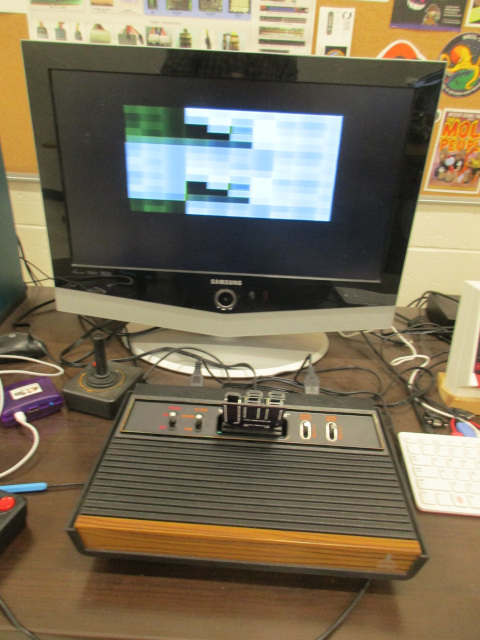
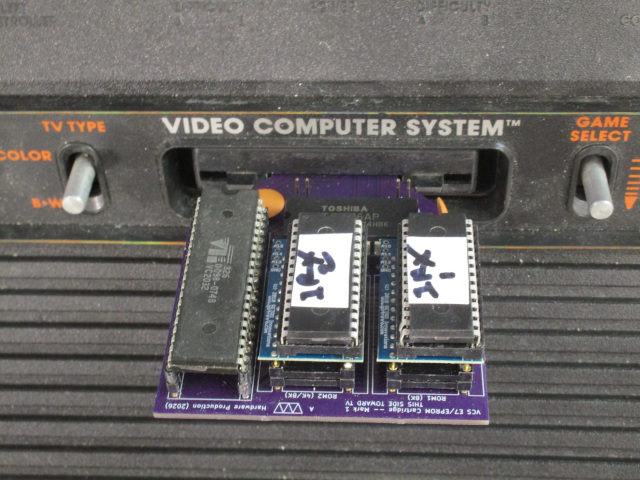
| Screenshot | Effect | Description |
|---|---|---|
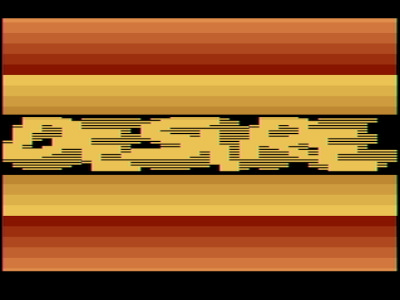 |
Title screen | ROM BANK0: Various desire logos. These are using the four 256 banks. There's a common set of playfield data for the logo, but the foreground/background color variations are copied to the four RAM pages, and then banked in and out. There's a slight fade effect for the first two, I meant to have it fade all the way out but that's tricky to do in the cycle budget. |
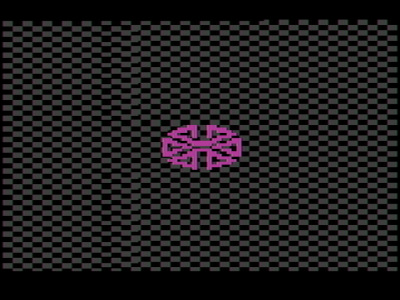 |
Bouncing Cube | ROM BANK1: The SGI logo at various sizes and bouncing around the screen. Mostly showing off some of the sprite options. Not using any RAM. Had originally planned to animate and/or go behind the background, but ran out of time. |
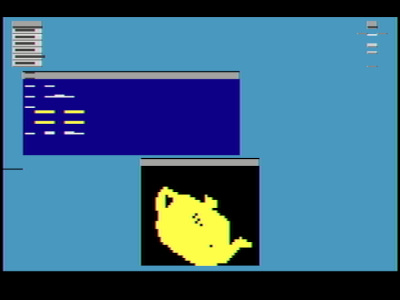 |
Teapot Desktop | ROM BANK2: showing a fake IRIX desktop. At first it looks like it's static, with playfield graphics and a sprite overlay for extra color. But then the teapot starts animating. I actually have 8 frames of animation but could only fit 4. The data for that (a standard atari 2600 48-pixel setup) is compressed in ROM, ZX02 decompressed to the large 1k RAM, then copied to the four pages of 256-byte banked RAM. Ideally I'd be able to fit 8 frames here, but couldn't figure out a good way to get everything in memory. Also the 1k range is hard to use, since it replaces ROM you can only really use it from the 1.5k always-mapped region but that ROM space is limited. |
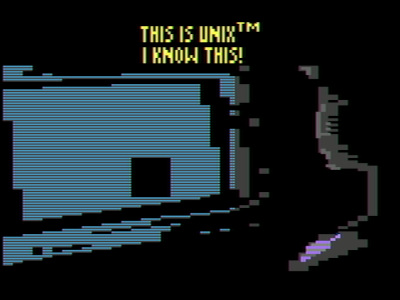 |
Know This | ROM BANK 3: Based on a scene from Jurassic Park, where the young hero realizes the park is being run on SGI Irix for some reason. Mostly static backgrounds with one set of sprite overlays for extra color. I intended to have a second sprite overlay and possibly even a smaller teapot animation on the screen but ran out of time. No RAM was used for this. |
 |
Sierpinski |
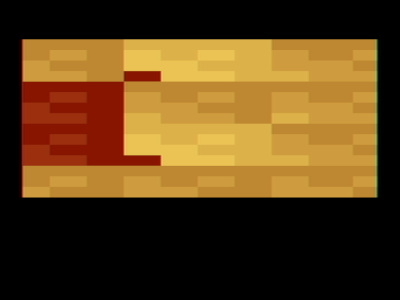
BANK4: This was my attempt to use the RAM to get a lot of
colors on the screen at once. I managed 10, all using
the playfield (I think other groups have gotten 11 by
using all the various sprite/ball/playfield elements).
The unusual thing about this is the box drawing code lives in RAM, in 3 of the 256-byte banks. At startup the load constant/store out code is written to RAM, and then to change the color being drawn you self-modify this code to change the immediate values. This lets you change colors in only 2 cycles rather than 3 (ZP) or 4 (read from ROM) allowing more changes per line. The end result is not very dense, but it is a crude fully addressable 10x15 grid. I had various ideas of how to show this off but in the end the best I managed was this which is Sierpinski but with the colors shifting a bit. I was hoping for a lot more here, maybe a plasma, or visualization but ran out of time. |
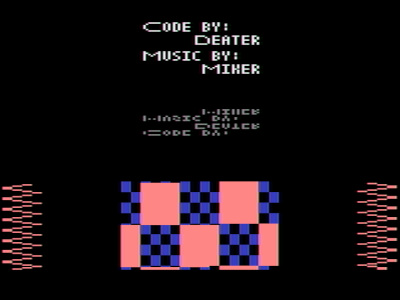 |
Credits | BANK5: credits with a mirror effect. These credits live in the 256-byte bank switched area. I have a font routine (up to 32 4x8 characters) that can print to the page. The mirror effect is just printing the same data upside down and alternately skipping lines. I had hoped to have the text scroll, but even though we're only display 42 lines (42x6-bytes fits in 256 bytes) scrolling them all up takes way too many cycles to fit in one frame and it's a hassle splitting it across multiple frames w/o tearing. The bottom half of the screen with the parallax and waves is re-used from a previous demo of mine. |
| n/a | Music | ROM BANK6 has the music, written by MikeR with TIAtracker. I used the export to generate the code and then hand-hacked it for ca65 assembly language. There's a trampoline in the common area so you can call into the music code (which takes roughly 11 scanlines) from any ROM area. |